
26. August, 2026
Leibniz Institute for Polymer Research (IPF)
13:00 - 17:00
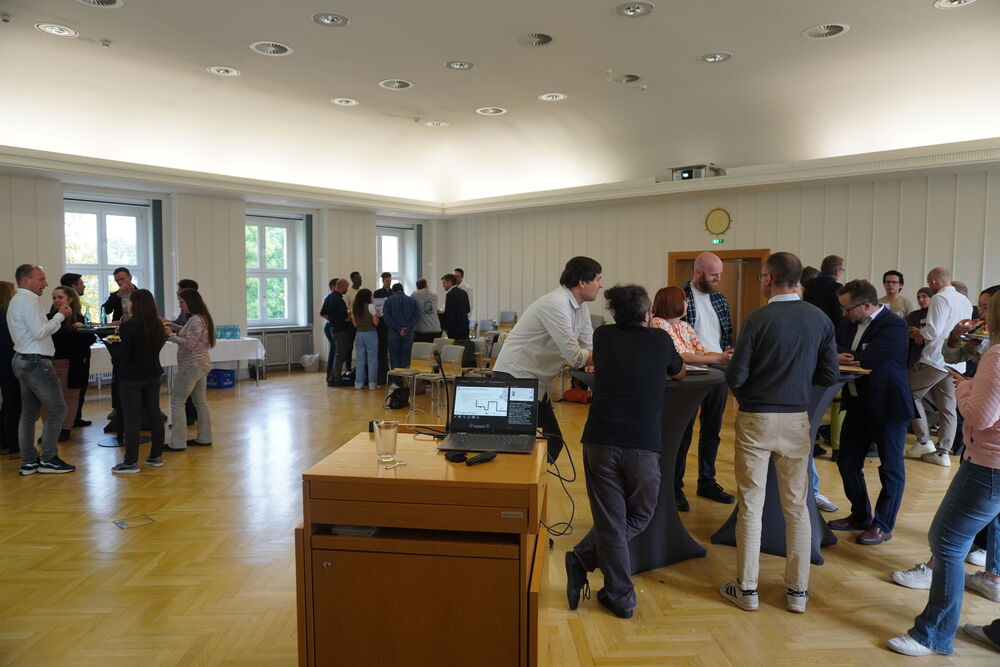
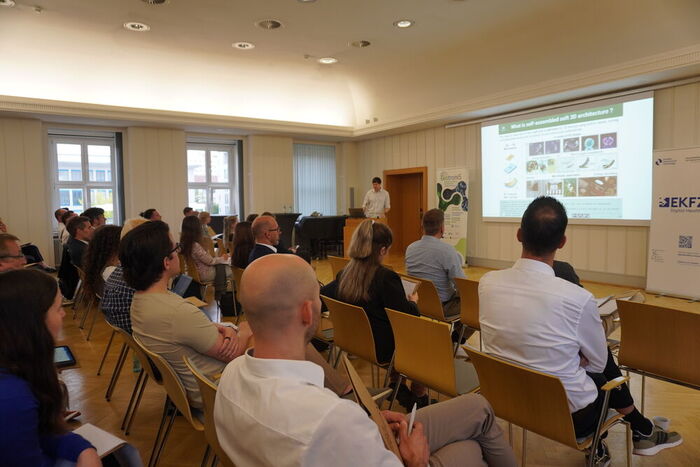
On 26 August 2026, researchers, clinicians, industry representatives and innovators came together at the Leibniz Institute of Polymer Research Dresden (IPF) for the Innovation Meetup: Soft Bioelectronic Interfaces. The event brought together expertise from different disciplines to exchange ideas on the latest developments in bioelectronics and explore how emerging technologies can move from fundamental research towards clinical and industrial applications.
Jointly organised by BiotroniS, the Else Kröner Fresenius Center (EKFZ) for Digital Health at TU Dresden and the Innovation Cluster SEMECO, the meetup combined short scientific pitches, laboratory tours and interactive roundtable discussions, creating opportunities for both knowledge exchange and new collaborations.
From electrode arrays to artificial neurons: the Pitch Session
Following the opening remarks, eleven speakers presented their research and ideas in a fast-paced Pitch Session. Each speaker had five minutes to introduce a particular challenge, technology or application in the field of bioelectronics.
The session featured:
Prof. Ivan Minev (IPF, EKFZ) – Challenges and Innovation for Electrode Arrays in Bioelectronics
Dr. Witold Polanski (UKD) – Deep Brain, Hard Problems, Soft Solutions: A Neurosurgeon's Perspective on Bioelectronic Interfaces
Dr. Taral Patel (Celtro GmbH) – Bioelectrical Energy Harvesting and Human Tissue Stimulation
Daniel Nieder (HZDR) – Unlocking the Power of In Vitro Monitoring through Bioelectronics
Dr. Sarah Tsurkan (EKFZ, TUD) – SEMECO & EKFZ: Bridging Innovation and Transfer
Dr. Mikhail Tsurkan (TissueGUARD GmbH, IPF) – Sacrificial Hydrogels for Regenerative Therapies
Dr. Ali Solgi (TUD) – The Future of Continuous Cell Monitoring
Prof. Christian Matthus (KSI, TUD) – Compact Modeling of Organic Electrochemical Transistors for Design of Artificial Neurons
Dr. Franz Selbmann (Fraunhofer ENAS) – Parylene for Medical Packaging and Interfaces: Encapsulation, Ultra-Thin Electrodes and Wearables
Tönnis Trittler (EKFZ, TUD) – MEMS Goes Medical – Integration of Pressure and Ultrasound Sensors for Noninvasive and Invasive Blood Pressure Sensing
Dr. Aleksandr Egunov (MAIN, TU Chemnitz) – Self-Assembled Soft 3D Microfluidic Architectures for Bioelectronic Systems
Together, the pitches illustrated the breadth of modern bioelectronics – from organic electrochemical transistors, soft electrode arrays and microfluidics to regenerative medicine, neural interfaces, continuous cell monitoring and medical sensing.
Exploring technologies in the laboratory
After the Pitch Session and coffee break, participants took part in Guided Lab Tours at IPF. Divided into four groups, participants rotated between four stations, spending approximately ten minutes at each.
The four stations provided insights into:
- 3D Printing – Room B216
- Bioelectronics – Room L011
- Raman/Microplastics Analysis & Ellipsometry – Room H224
- Polymer Separation & NMR – Room H224
The tours offered participants the opportunity to see experimental methods and technologies first-hand and to connect the scientific topics discussed during the pitches with the facilities and techniques used in ongoing research.
Following the innovation journey through roundtable discussions
The final interactive part of the meetup was dedicated to Innovation Roundtables, designed around the different stages of the bioelectronic innovation journey – from creating new technologies and understanding biological systems to healthcare applications and successful research transfer.
Four thematic tables were offered:
1. Design – Creating the next generation of bioelectronic systems
Led by Prof. Ivan Minev (IPF, EKFZ), Dr. Mikhail Tsurkan (TissueGUARD GmbH, IPF) and Dr. Aleksandr Egunov (MAIN, TU Chemnitz).
2. Measure – Understanding biology through smart sensing
Led by Prof. Christian Matthus (KSI, TUD), Dr. Ali Solgi (TUD) and Daniel Nieder (HZDR).
3. Apply – Advancing healthcare through bioelectronics
Led by Dr. Witold Polanski (UKD), Dr. Franz Selbmann (Fraunhofer ENAS) and Tönnis Trittler (EKFZ, TUD).
4. Translate – From research to impact
Led by Dr. Sarah Tsurkan (EKFZ, TUD), Dr. Taral Patel and David Osmanović (Celtro GmbH), and Dr. Dominik Gronarz (Organic Electronics Saxony e.V.).
Participants selected the table that best matched their interests and expertise. After the first 25-minute discussion round, they had the opportunity to change tables for a second round, enabling exchanges across different areas of the bioelectronics innovation pipeline.
Bringing the bioelectronics community together
The Innovation Meetup highlighted how strongly the future of bioelectronics depends on collaboration across traditional disciplinary boundaries. Materials scientists, engineers, clinicians, biologists, entrepreneurs and technology-transfer experts approached bioelectronic interfaces from very different perspectives, while sharing the common objective of translating innovative research into technologies with real-world impact.
Beyond the scientific programme, the event provided an important space for networking, exchanging ideas and identifying opportunities for future collaboration between research institutions, healthcare, start-ups and industry.
The Innovation Meetup: Soft Bioelectronic Interfaces thus continued the BiotroniS Innovation Meetup series by bringing together the Saxon bioelectronics community and strengthening connections across research, technology development and application.
© BiotroniS, Hohe Straße 6, 01069 Dresden
Source: https://en.biotronis.de/mitteilung/Innovation_Meetup%3A_Soft_Bioelectronic_Interfaces