



27. February, 2026

HTW Dresden
10:00 - 12:00
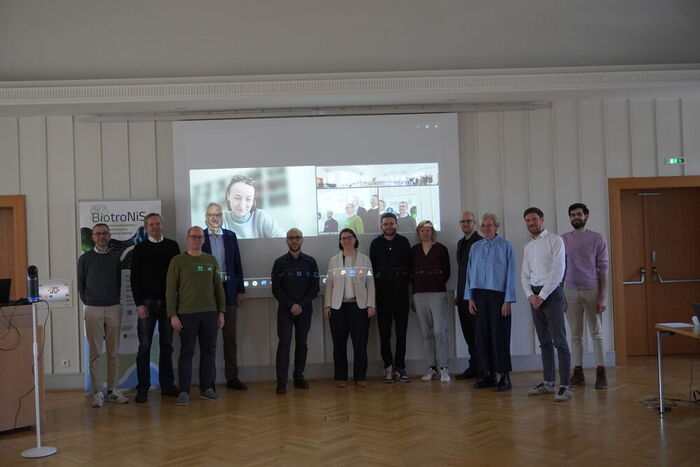
The BiotroNiS network held its General Assembly on 27 February 2026 to reflect on the past year and outline strategic steps toward establishing a dedicated bioelectronics society. The meeting highlighted the network’s rapid development, growing visibility, and its ambition to position Dresden as a central hub for bioelectronics in Europe.
A Look Back: Consolidating Structure and Collaboration
BiotroNiS has matured into a coordinated, multi‑institutional effort. Coordination is led by the Leibniz Institute for Polymer Research Dresden (IPF), communication by the Technische Universität Dresden (TUD), and technology transfer by Centre for Applied Research and Technology (ZAFT) at University of Applied Sciences (HTW) Dresden. The network also includes a broad set of associated partners such as Fraunhofer institutes, IFW Dresden, DZNE, and the University Hospital Carl Gustav Carus.
In 2025/26, the network identified its four foundational pillars—research, industry cooperation, communication, and technology transfer—and strengthened connections across Saxony’s innovation landscape. As the document notes, BiotroNiS aims to “interlink Saxon research activities in bioelectronics” and unlock “valuable technology development with industrial partners.”
Key achievements include:
Expanded cooperation with Organic Electronics Saxony, Silicon Saxony, biosaxony/leap:up, Saxony5, and futureSAX.
Stakeholder and network analyses to map competencies and needs.
Launch of the BiotroNiS website and increased presence on LinkedIn and the Wisawi platform.
Successful workshops and structured event formats, including the Cambridge–Dresden Bioelectronics Symposium.
Technology transfer tools, such as a transfer questionnaire and the introduction of Innovation Readiness Level (IRL) assessments.
These activities significantly increased the network’s visibility and helped establish Dresden as an emerging centre for bioelectronics.
Outlook for 2026: Events, Infrastructure, and Innovation Tools
The upcoming year is shaped by a rich program of events and strategic initiatives. Highlights include:
- Cambridge–Dresden Bioelectronics Symposium (15–16 June 2026), featuring keynote speakers such as John Rogers (Northwestern University), Sahika Inal (KAUST), Eleni Stavrinidou (Linköping University), and Nicholas Vachicouras (Neurosoft Bioelectronics).
- MONAMINT Workshop, OES Business Breakfast: BioSens, Silicon Saxony Days, and the Sächsische Innovationskonferenz.
- Innovation Meetup Series on topics such as soft bioelectronic interfaces, printed bioelectronics, and sensors for health and agriculture.
- Transfer‑Scouting, using structured interviews to identify promising projects early and shorten the path from research to application.
Digital infrastructure will also expand. The website will continue to grow and be kept up-to-date with the latest developments in the field.
Strategic Steps: From Regional Network to International Society
A major focus of the assembly was the long‑term development of BiotroNiS. The network outlined a three‑phase trajectory:
1. Establishment Phase (2025–2026) Building initial services such as workshops and the symposium, collecting data, and conducting stakeholder analyses.
2. Transition Phase (2026–2027) Developing a full service catalogue, defining unique selling points, and evaluating potential legal forms.
3. Independent Network (from 2028 onward) Moving toward financial independence, expanding international partnerships, and formalizing governance structures.
The service catalogue under development spans four domains:
Networking — databases, cooperation platforms, partner matchmaking, and political representation.
Knowledge Transfer — workshops, conferences, and thematic networking events.
Public Outreach — exhibitions, demonstrator development, website, LinkedIn, podcasts, and a future Bioelectronics Journal.
Technology Transfer — IRL assessments, IP support, and assistance with spin‑offs.
A network analysis presented during the assembly emphasized a striking gap: there is currently no global society dedicated specifically to bioelectronics. This positions BiotroNiS to fill a unique niche and potentially become the first international organization in this field.
The General Assembly made clear that BiotroNiS is evolving from a regional initiative into a platform with international ambitions. With strong institutional backing, a growing community, and a clear strategic roadmap, the network is well positioned to shape the future of bioelectronics—scientifically, technologically, and societally.
© BiotroNiS, Hohe Straße 6, 01069 Dresden
Source: https://en.biotronis.de/mitteilung/BiotroNiS_General_Assembly_2026%3A_Strengthening_Saxony%E2%80%99s_Bioelectronics_Ecosystem